
Give agents work.
Not blind trust.
More work delegated. Clear limits on what agents can do. A record of who did what.
False Systems is building infrastructure for teams that want to move faster without handing over control.
Discuss your workflow ↗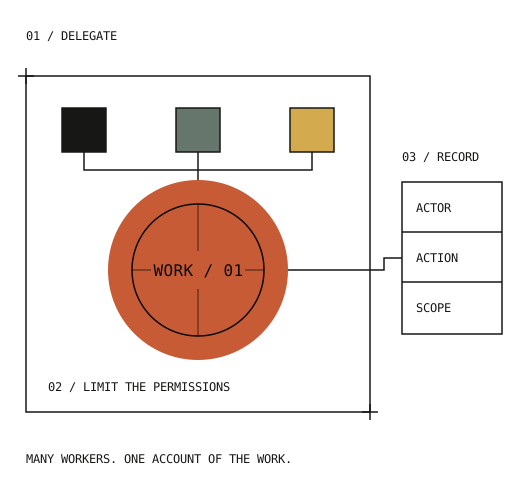
Delegate the task.
Not the keys.
An agent fixing one problem shouldn’t need access to everything. Set the scope of the work, limit its permissions, and keep decisions that need human approval with people.
Habitat’s runtime foundations tie limited authority to the work and the worker currently responsible for it. Full credential brokerage and broader production integrations are still in development.
Different teams.
One account of the work.
Engineering sees a task. Operations sees a change. When something goes wrong, neither should have to piece the story together from chat, tool histories, and an agent’s own explanation.
The goal is a record that follows the work across tools: who acted, what they were allowed to do, and what actually happened. Something another team can examine—not just take on trust.
- Who did it?
- Connect the action to a person or agent.
- Was it allowed?
- Connect the action to the permission behind it.
- What happened?
- Distinguish a request from a confirmed result.
- Can we check?
- Keep the supporting records—and make gaps visible.
A worker stops.
The work shouldn’t disappear.
A failed agent shouldn’t mean losing the task’s identity, its history, or the results already kept. Habitat separates the work from the worker carrying it out.
Retained results and journals provide a basis for recovery. Moving an unfinished workspace between machines is different—and remains in development. This is not a promise that every task resumes automatically.
See how Habitat preserves work ↗The controls behind
the confidence.
Execution, permission, and records have separate jobs. You shouldn’t have to understand the wiring to understand the value.

01Can we keep working locally?
The design keeps local work independent. Shared coordination is for shared decisions, permissions, and resources—not a central approval step for every local action. Client provides the local interaction and context.
02Does a connection grant access?
No. Gateway’s role is to connect clients to customer infrastructure while preserving identity. Being able to reach a machine must not mean being allowed to use every resource on it.
03Who decides what agents may do?
People set the boundaries. Control Plane is the shared coordination, policy, and approval responsibility; Habitat enforces custody-bound authority in its runtime. The broader approval and credential-broker experience is still being developed.
04Do we have to trust the agent’s report?
An agent’s account of itself is not enough. Evidence is intended to support records that others can inspect and independently verify. A recorded request does not prove an external change succeeded, and missing evidence does not prove nothing happened.
Shared evidence need not block every execution event. Authorization and runtime durability stay with the runtime; gaps in published records must remain visible.
05What can we evaluate today?
Habitat’s implemented runtime foundations include custody, generations, narrowing grants, journaling, retained results, and supported mediated HTTP effects. These are not a claim that the complete platform workflow is available.
The connected local-to-remote experience, full credential broker, and cross-host handoff remain in development.
Read the implementation boundaries ↗What would you delegate
if you could trust the boundaries?
Bring a real workflow. Let’s examine the permissions, failure cases, and records it needs.